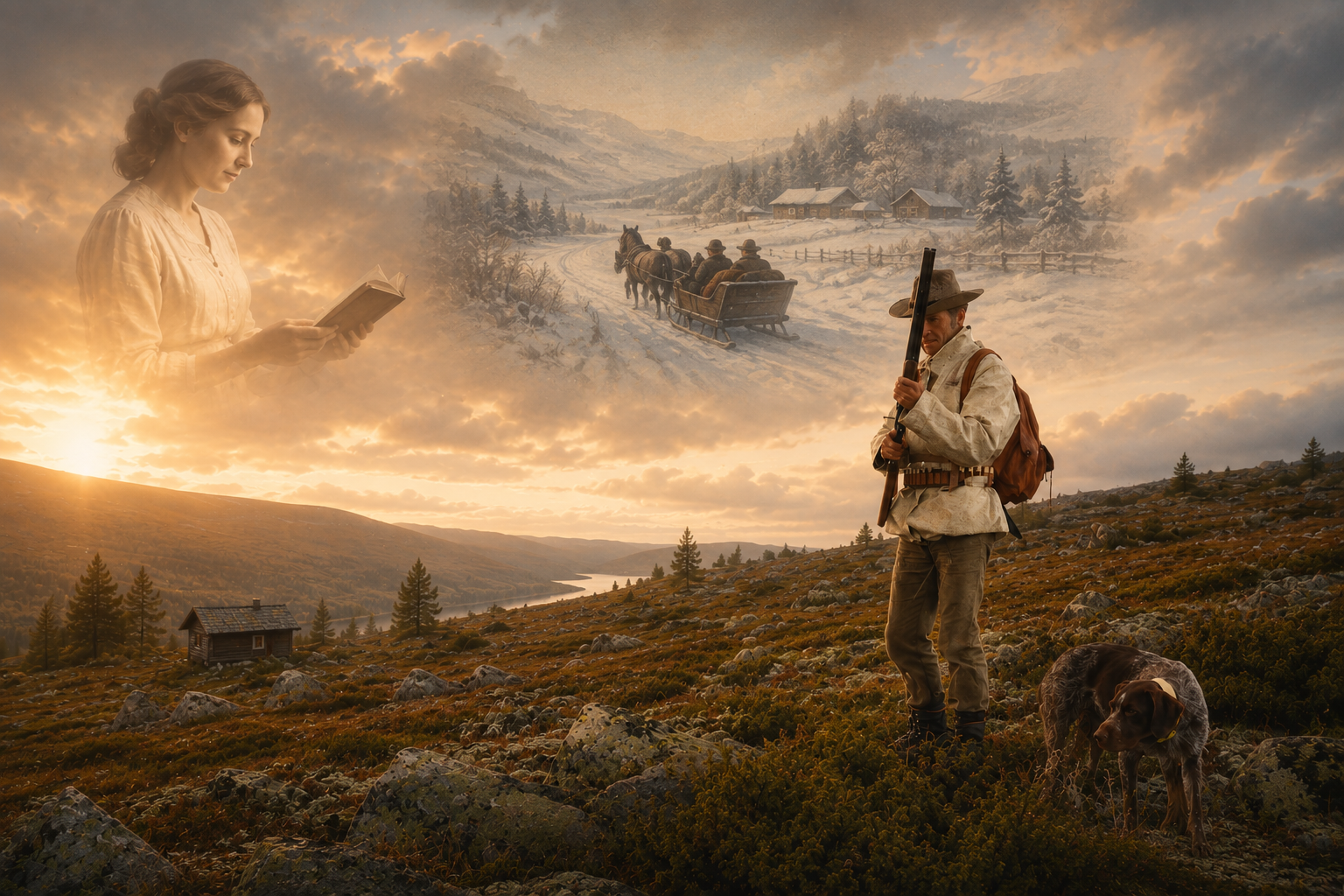
Last week, an old photo suddenly surfaced.
A simple photo of a Norwegian hunter with his dog. A photo from his own collection, which he gave us over thirty-five years ago. To most people, it is an insignificant snapshot. To me, that photo tells a story that spans almost a lifetime. A story about Mima. About a book. About Norway. About dementia. And about a man who never knew how much influence he had on my life. The photo was the impetus to tell that story again.
The story itself, however, begins much earlier.
Pipa, my grandfather, gave Mima, my grandmother, the book *Het Geslacht Bjørndal* by Trygve Gulbranssen as a gift. I do not know exactly when. That story has never been preserved with such accuracy in our family. Over the years, I have formed my own interpretation of it, which will eventually be published. The Dutch translation appeared a few years before the Second World War. Pipa and Mima lived in Rotterdam. During that period, Pipa was stationed in Limburg as a soldier. My oldest uncle was born two years before the war, and my mother came into the world on April 12, 1940, less than a month before the Netherlands was invaded.
I like to imagine that Pipa gave the book to Mima around the time of my uncle’s birth. A gift to his young wife, during a period when he was frequently away from home and the world around them was becoming increasingly turbulent. I do not know if it actually happened that way. Nevertheless, that image helps me understand why this book held such a special place in her heart. I am now reading the book myself and recognize its power. Gulbranssen describes the Norwegian nature, the farms, and the people so vividly that, as a reader, you are completely drawn into the story. You are not just reading about Norway; you are there for a moment.
I can imagine that precisely that must have been invaluable during the war. Rotterdam was bombed. The city where Mima lived changed forever. She was a young mother in a time of fear, scarcity, and uncertainty. While the world around her grew smaller and smaller, this book opened a door to a world without war. To vast forests, to mountains, to snow. To a land where peace, freedom, and nature played the leading role.
I can no longer ask Mima if she truly experienced the book in that way. That thought has never left me. For in my mind, Norway became much more to her than the backdrop of a beautiful story. It became a place she could travel to again and again, without ever leaving her chair. That is where the love for Norway originated, which would eventually run through our entire family.
Mima passed that love on to my mother. My mother subsequently infected my father with the same Norway virus. And without realizing it at the time, I too grew up with stories about a country I had never been to. Norway became a dream that connected generations. For Mima, that dream persisted her entire life: She was never there!! That realization still touches me. Her story has taught me that you should not endlessly postpone important dreams. Do what is important to you when the opportunity presents itself. Later is no promise!! Before you know it, later is over!! And then the future you once longed for so much has become an unfinished past.
Over thirty-five years ago, we went to Norway again as a family. We had already been there a few times in the summer, but this was the first time we would experience the country in the winter. My two oldest brothers stayed home. They were at the age where a winter sports holiday with your parents suddenly becomes a lot less appealing. That is why my parents went with two of my brothers and me to the area around Lillehammer.
On one of those days, we went on a sled ride. During that ride, my mother told the story of *The Bjørndal Family*, simply in Dutch. Halfway through, the sled driver turned around. “The story you are talking about,” he said. “That is based on my family.” We looked at each other in surprise; after all, the book was a novel!! When we returned to his farm, he walked inside and came back with his driver’s license.
His name was Odd Dag Bjørndal.
A moment later, he showed a letter from writer Trygve Gulbranssen. In it, the writer thanked his ancestors for their hospitality and for the inspiration their history had provided for the writing of the books. At that moment, a novel suddenly took on a face. Before we left, Odd Dag walked back inside. A moment later, he returned with a photo of himself. A simple snapshot of him standing with his dog.
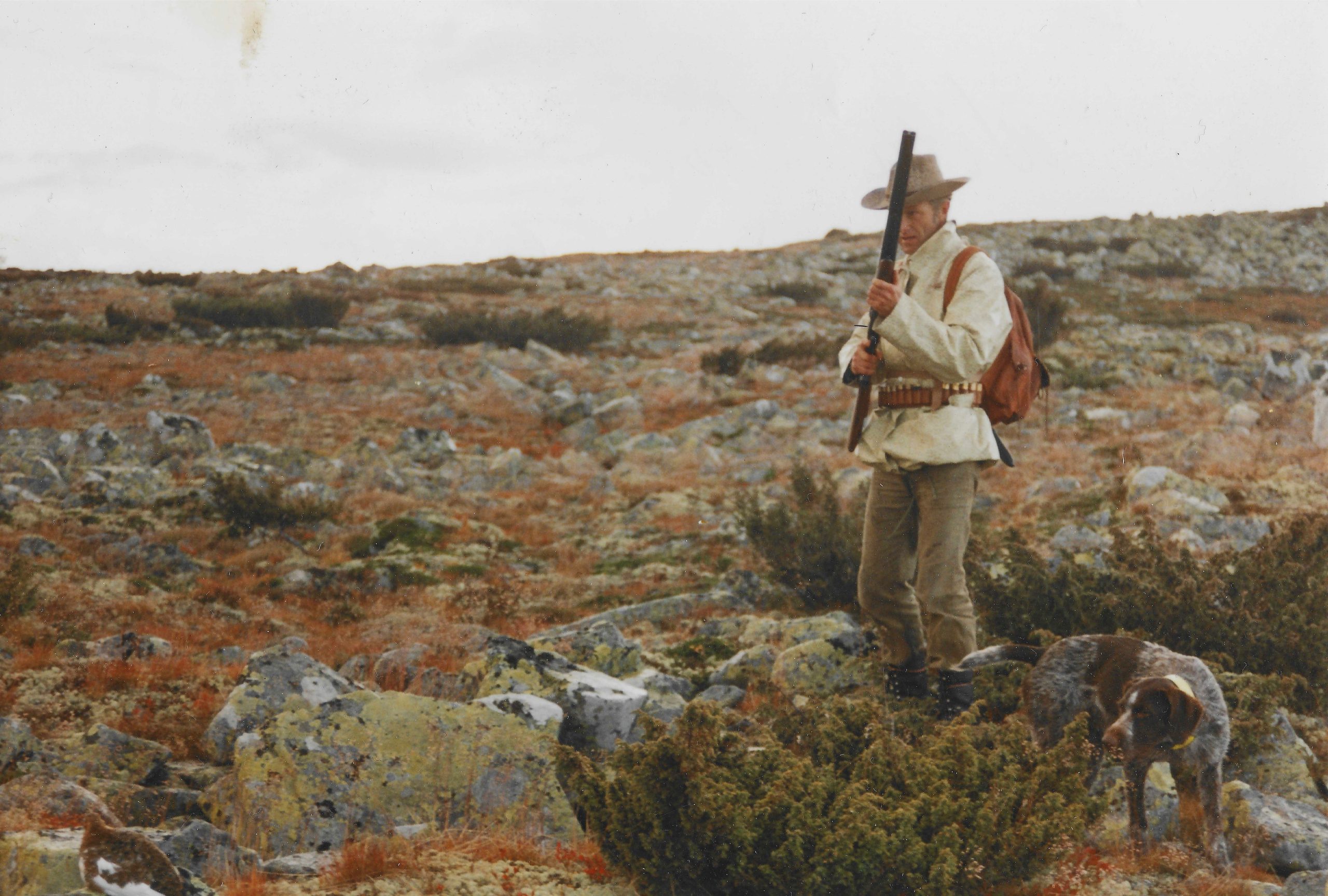
He gave us the photo as a memento of our meeting. For him, it was a very ordinary gesture. For us, it became a memory for life. Back in the Netherlands, we showed the photo to Mima. By then, she was suffering from dementia. The moments when genuine contact was still possible were becoming increasingly rare. Yet, something happened when she saw the photo. Her eyes began to sparkle. She recognized the story. She recognized Norway. For a brief moment, the distance caused by dementia vanished, and a part of her old world came to life again.
That moment has never left me.
Since then, I know that you should never give up on people with dementia. Even when someone seems to be slipping away further and further, memories can unexpectedly resurface. That is precisely why continuing to visit is so important. Not every visit will yield a special moment. You just never know which visit will open the door to a memory again.
A year and a half ago, I traveled to Norway again. Actually, I was looking once more for a story that had accompanied me for decades. I wanted to meet Odd Dag Bjørndal one more time. I wanted to tell him what that one photo had meant to Mima. I wanted to tell him that, without ever realizing it, he had left behind one of the most beautiful memories in our family history. When I discovered that I had already been very close to him during that trip—he was in a hospital in the vicinity of Lillehammer, something I did not yet know when I was there—it was too late. Odd Dag Björndal had passed away surrounded by his sons.
That news affected me more than I had expected.
That was not because I had known him so well. On the contrary! I had only met him for one afternoon/evening. But some encounters last much longer than an afternoon or evening. I did have contact with his sons (and I think even with his daughters-in-law, but that is another story). Their relationship with their father was complicated, and they did not want any further contact. I fully respect that.
As a result, Odd Dag Björndal never knew what that one photo had meant to Mima. He never knew that he taught me to keep visiting people with dementia.
He never knew that he made me realize that you shouldn’t postpone important dreams.
And he never knew that that one photo, decades later, would be the catalyst for this story.
That is the power of a small gesture. For Odd Dag, it was a photo from his own collection. A simple snapshot that he gave to a Dutch family he had met a few hours earlier. For Mima, that same photo brought her beloved Norway close one last time. And for me? For me, that photo became a life lesson.
And that is surely the most beautiful thing about a legacy: Not what you consciously leave behind, but what lives on without you ever knowing that you passed it on. You can never foresee the significance a small gesture will take on in someone else’s life. Something that is barely more than a friendly moment to you can grow into a memory for someone else that lasts a lifetime.
You do not know which memory you are keeping alive.
You do not know which choice you are influencing. You do not know what lesson you pass on without being aware of it.
Therein lies the true legacy that a person can leave behind.
