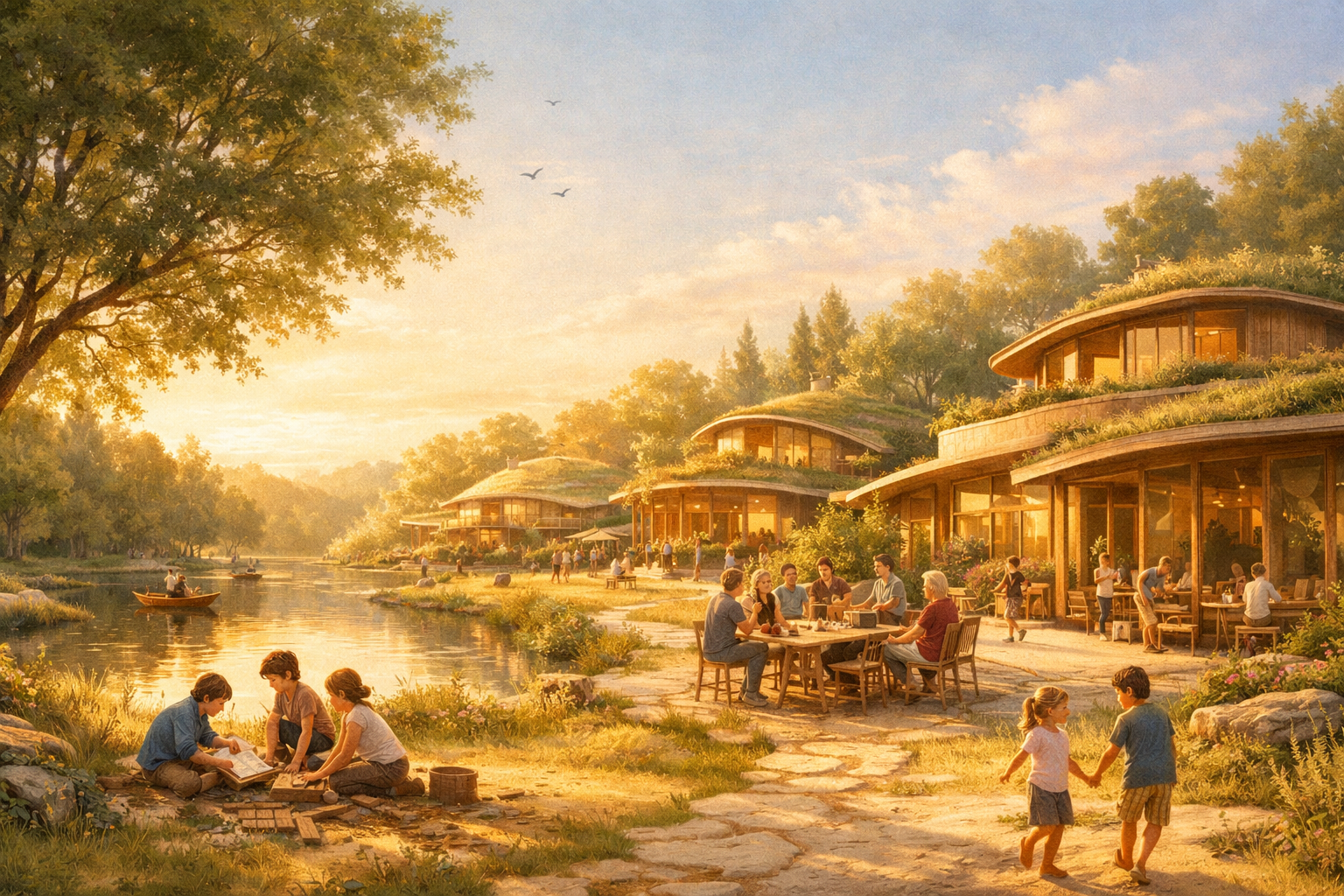
In 2050, the world has become quieter. Not empty or withdrawn, but calmer in tone. The haste that once permeated everything has disappeared from daily life. Not because people have less to do, but because time is theirs again.
In that world, Uw-Topia doesn’t exist as an institution you “have to go to.” It’s not a spot on a map, not a head office with a logo on the facade. Uw-Topia has become a given. A way of living together that has so deeply penetrated education, living, and working that no one calls it anything special anymore.
Children grow up in environments that don’t shape them to a system, but where the system continually shapes itself to the child. Schools resemble villages. Open, light, with places to learn, to wander, to play, to rest. There are no hallways lined with closed doors, but spaces that invite encounters. Learning happens in relationships: with each other, with the world, with what truly matters. Not everyone learns the same way, and that’s okay. Difference isn’t a problem to be solved, but a richness that should be visible.
Education is no longer about performance, but about growth. About understanding who you are, what you can contribute, and how you create meaning together with others. Technology is everywhere, but never dominant. It supports, slows down where necessary, and fades into the background as soon as humanity demands it.
Living has once again become a social concept. Houses are not next to each other, but with each other. Neighborhoods are designed as living ecosystems: young and old, alone and together, caring and cared for. No one is “left out.” Those who are temporarily vulnerable are not transported to another world, but remain part of the whole. Care is no longer a separate sector, but a shared responsibility, self-evident and reciprocal.
Work has also taken on a different meaning. It’s no longer about positions or titles, but about contribution. People work where their talents are utilized and where they are needed. Organizations are human in scale and transparent in intention. Decisions are made with an eye for long-term consequences – for people, for communities, for the planet. Efficiency still exists, but never at the expense of dignity.
In 2050, failure is no longer a stigma. It is visible, open to discussion, and instructive. Systems are designed to allow room for doubt, revision, and growth. Rules serve, not lead. They protect what is vulnerable and create space for what wants to emerge.
In this world, Uw-Topia is no longer a movement advocating for humanity, because humanity has become the norm. The questions that were once central-What is good education? What is dignified housing? How do we organize coexistence?-are still asked, but without struggle. They have become part of an ongoing conversation, conducted with gentle eyes and strong values.
And perhaps that is the most utopian thing of all:
that in 2050, no one will say, “This is Uw-Topia,”
but that people will simply say:
This is how it should be.
