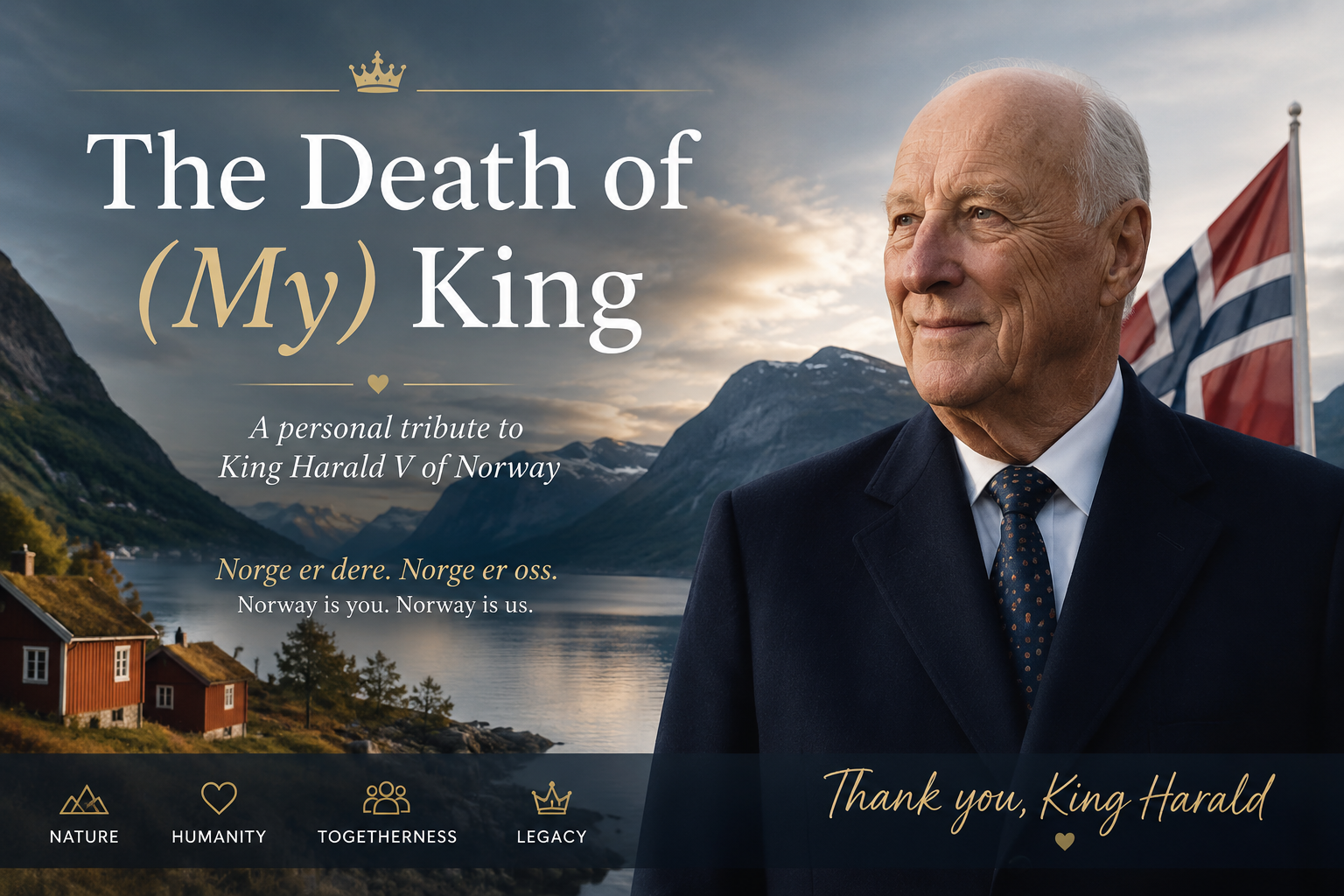
Norway is in my blood.
Not literally, of course. I was not born there and I have never lived there. Yet those words do not feel exaggerated to me. I have been coming to Norway since I was a child. A year and a half ago, I spent six months travelling through the country. I know the endless roads, the mountains, the silence, the fjords, the small towns, and that extraordinary feeling that comes over me every time I am there. Norway feels like a second home to me. At times, perhaps even my first.
That is why the death of King Harald V affects me more deeply than I could have anticipated.
I never met him. I knew him the way almost everyone outside his immediate circle knew him: from a distance. Yet, to me, he belonged to Norway. Just as the mountains, the fjords, the red wooden houses, and the flags you see everywhere belong to the country. Never demanding attention, yet somehow always a natural part of it.
Today, that sense of permanence has disappeared.
Harald had been King of Norway since 1991. He was 89 years old and, at the time of his death, the oldest reigning monarch in Europe. For more than thirty-five years, he wore the Norwegian crown during a period in which Norway changed, while the world around it changed at least as profoundly.
Yet when I think of Harald, I hardly think of a crown.
I think of a man.
That is probably one of the reasons he was so loved. Harald seemed to understand that the authority of a modern king does not grow through distance from his people. His dignity was often found precisely in his closeness to them.
There is a story about Harald that has always stayed with me. I have never been able to establish whether every detail happened exactly as it is told. The story takes place during the 1994 Winter Olympics in Lillehammer. Harald and his family are said to have chosen not to sit in a secluded royal stand during one of the events, taking their place among ordinary Norwegians instead. The explanation that accompanied the story has always seemed more beautiful to me than the question of whether every detail can be historically verified. That day, he was not there as king. He was there as a Norwegian, supporting Norwegian athletes.
It is the kind of story that stays with you because it fits the man.
Harald loved sport. Not simply from the comfort of a seat beside the field. He was an Olympic sailor himself and competed in three Olympic Games. He became a world champion and continued competitive sailing well into old age. Out on the water, much of what distinguishes people from one another on land disappears. The same wind, the same waves, and the same forces of nature determine what happens. A title makes little difference there.
That fits remarkably well with the image I have of Harald.
Away from sport, too, stories are told of a king who moved easily among other people, who could have lunch somewhere without the entire place first having to be transformed into a royal setting, and who remained approachable in a role that almost naturally invites distance.
The remarkable thing is that this ordinariness did not diminish his kingship. It gave it meaning.
His life with Sonja tells us something similar.
Sonja Haraldsen was not a princess. She did not come from a European royal house and therefore did not naturally fit the expectations surrounding a future Norwegian king at the time. Harald loved her and waited for years for permission to marry her. Eventually, he made it clear that his choice had been made. If he could not marry Sonja, he would not marry at all.
Their struggle lasted nine years before King Olav finally gave his consent.
In 1968, Harald and Sonja married.
Looking at such a story from our own time, it almost seems strange that someone’s background could once have been considered sufficient reason to keep two people who loved each other apart. Yet it tells us something essential about Harald. Long before he became king, he had already chosen something in his personal life that would return throughout his reign: the human reality mattered deeply to him.
That became visible in an entirely different way on 22 July 2011.
That day, Norway was struck by the attacks in Oslo and on Utøya. Seventy-seven people were murdered. A small country was confronted with a form of violence that was almost impossible to comprehend.
At moments like that, kingship takes on a different meaning.
A king cannot bring the dead back. He cannot remove the grief of parents, partners, children, and friends. He cannot undo history. What he can do is be present.
Harald was present.
His grief was visible. His tears were visible. When he later addressed the nation, he did not speak solely from his position as king. He also spoke as a father and grandfather.
It is precisely there that leadership can become deeply human.
We are accustomed to judging leaders by their words, decisions, power, and achievements. Yet there are moments when a society needs something else. No grand declaration can solve everything, because some events cannot be solved. At such moments, presence can be enough. Standing beside people. Acknowledging their grief. Allowing them to feel that sorrow does not have to be carried individually.
Harald understood that.
Several years later, he once again showed how he viewed his country.
In 2016, he gave a speech in which he tried to describe who Norwegians actually are. He spoke about people from the north, centre, and south of the country, about immigrants from Afghanistan, Pakistan, Poland, Somalia, and Syria, about girls who love girls, boys who love boys, and people who love one another. He spoke about Norwegians who believe in God, Allah, the universe, or nothing at all.
In the end, he captured it in a few simple words:
“Norge er dere. Norge er oss.”
Norway is you. Norway is us.
I still find those remarkable words coming from a king.
A monarchy is ultimately built on ancestry. You do not become king because, after a selection process, the population decides that you are the best candidate. You are born into a family, and through that birth an exceptional position awaits you.
Yet it was a man from precisely such an institution who told his people that belonging to Norway was not determined by ancestry, religion, sexual orientation, or the place where your cradle happened to stand.
Norway is us.
In those words, Harald expressed something about the Norway he wanted to represent. A country does not have to lose its identity when it makes room for people who are different. A society does not automatically become weaker when different life stories meet. A sense of community can also grow when people decide that they belong together.
That idea touches something at the heart of what I love about Norway.
My love for the country is, of course, also about its nature. Anyone who has ever stood beside a fjord while the light slowly changes understands how overwhelming that beauty can be. Anyone who has driven for hours along a Norwegian road and encountered hardly another person knows the sense of space and silence.
Yet a country is ultimately more than its landscape.
It is its people, the way they treat one another, their stories, their history, and the way a society tries to give shape to something larger than an individual life.
Harald belonged to that.
His grandfather Haakon VII became associated with Norwegian resistance to the German occupation. His father Olav V became known as the folkekongen, the people’s king. Harald inherited that history and had to find his own way of being king in a far more modern Norway.
He did so without constantly trying to appear larger than the country he represented.
That is a remarkable form of leadership.
Power easily creates distance. A position can gradually become more important than the person who holds it. Status can lead someone to encounter mainly people who are constantly aware of that status. Anyone who remains at the top long enough risks forgetting what life feels like further down.
Harald seemed to understand throughout his life that a crown ultimately has meaning only as long as the people beneath it are still seen.
That is why I love that story from Lillehammer, even though I cannot prove that every detail of it happened exactly as it has been told.
I can picture it.
A king among his fellow countrymen. No special place required. No distance constantly reminding everyone who is considered more important. Simply watching sport, hoping a Norwegian will win, cheering when things go well and feeling disappointed when they do not.
At that moment, not a king looking at his people.
Simply a Norwegian among Norwegians.
Today, Harald is no longer here.
His son Haakon takes his place, and Norway continues, as countries always do. A new king, a new period, and eventually new stories that will become part of the country’s history.
Yet with Harald, something disappears that for a very long time seemed permanent.
For me, someone has also disappeared who belonged to the Norway I came to love. That may sound strange when writing about someone I never personally met. Grief rarely respects such boundaries. We can be affected by someone’s death because that person has become connected to something that carries meaning in our own lives.
Harald was such a person for me.
When I think of Norway, I think of mountains, fjords, long roads, silence, snow, wooden houses, flags, encounters, and memories that have become part of my own life.
And somewhere among all those images, there was always that friendly older man who happened to be king and who never seemed to feel the need to constantly prove that he was.
A crown makes someone a king.
The way a person stands among other people ultimately tells us far more about who he is.
Farewell, King Harald.
Thank you for the way you belonged to Norway.
And through that, for belonging just a little to my Norway as well.
Norway is you. Norway is us.
Today, that final word feels just a little different.

Heel bijzonder mooi verhaal. Je hebt je echt verdiept in de biografie van de koning. Daar mag je met recht een blog over schrijven, maken. Prettig om te lezen.
Dank je wel, Ik volg Noorwegen al heel erg lang. Op deze site vind je ook meerdere blogs over bijvoorbeeld 22 juli en alles wat daar mee te maken heeft. Vandaar dat ik me nu ook graag in zijn leven heb verdiept om deze blog te schrijven. Een deel had ik eerder deze week al geschreven en opgezocht, toen hij opgenomen was in het ziekenhuis.